Am I Living in a Martin Parr Photo?
- Rory Wilmer

- Jul 12, 2025
- 3 min read
The flash bulb pops in my mind—bright, merciless, catching me mid-blink. Saturated colours burst around me: ice creams vividly pink, deckchairs brutally striped, gulls frozen mid-attack over greasy cones of chips. New Brighton, eternally captured in Martin Parr’s decisive moment, remains fixed between nostalgia and realism, glory and grit.

Parr arrived here in the early 1980s, camera slung casually, eyes sharp, capturing precisely what the rest of Britain often overlooked. Between 1983 and 1985, he immersed himself in this town, compelled by its unapologetic roughness, its faded grandeur, and what he described as its “energy and litter.” The result was The Last Resort, a photographic essay that still reverberates with powerful, uncomfortable honesty.

Consider the two children standing on the promenade. Faces comically smeared with melting ice cream, they epitomise innocence and indulgence—one clutching a plushy toy, the other gazing upward, distracted and dreaming. Behind them sits a shelter, ornate but weary, elderly visitors quietly watching life unfold, the distant lighthouse marking the boundary between land and sea.

Then, step inside the chippy. It’s a crowded, chaotic scene—teenagers and families fresh from swimming jostle impatiently, ketchup and crumbs scattered freely across the counter. Parr frames ordinary moments as epic dramas of mundane desperation and small joys. The eagerness, the mess, the quiet dignity of seaside hunger—all captured and amplified through his unflinching lens.

Outside, under the seaside shelter, a couple sits serenely amidst scattered litter, seemingly unaffected by the overflowing bin dangling precariously above them. A baby in a stroller watches, untroubled by the debris. A woman points into the distance, hinting at unseen stories unfolding beyond Parr’s frame. Here again, Parr reveals resilience and dignity amid the detritus, quietly subverting the expected narratives of decay.
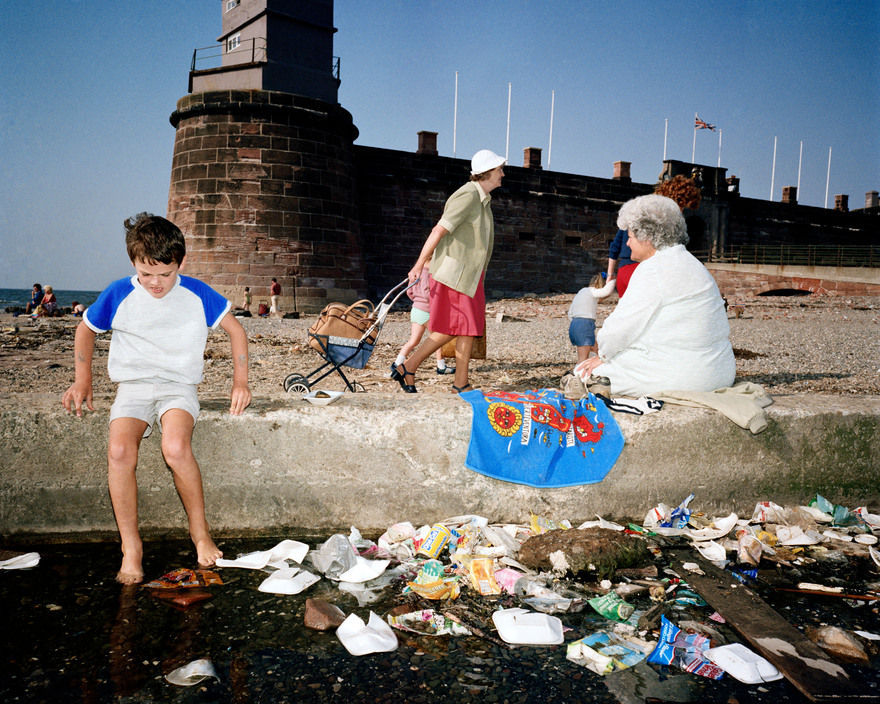
At the Fort Pearch Rock, a boy sits precariously above water thick with floating rubbish, seemingly oblivious or accustomed to the neglect around him. An elderly woman relaxes nearby, casually indifferent to the plastic and litter at her feet, as another passes by, stroller in tow. Leisure coexists starkly with pollution, an uncomfortable yet truthful portrayal of seaside reality.

And then, the ice cream stand —the young woman behind the counter gazes defiantly, her stern authority juxtaposed against the impatient crowd of shirtless youths eagerly grasping their cones. It’s a scene simultaneously humorous and poignant, an embodiment of fleeting summer tensions caught sharply by Parr’s meticulous framing.
But here’s the surrealist trick: I’m not merely looking at Parr’s photos—I’m living inside them. Trapped behind glass, within the glossy sheen of postcard snapshots, these vivid, hyper-real moments define my world. To live here, as a photographer, writer, or artist, means constantly negotiating with this monumental visual legacy—to accept Parr’s gaze without being bound by it.
How do I step beyond Parr’s powerful depiction without rejecting what makes it compelling? Perhaps, paradoxically, the answer isn’t to escape but to embrace. Parr captured resilience and defiant humour amid hardship, saw heroism in the everyday, the poetic amid the prosaic. Maybe our way forward is to lean into this paradox, celebrating absurdity and elegance side by side, yet deliberately introducing movement, imagination, and evolution.

Imagine a promenade where teenagers freely wheelie down the UK’s longest seaside path, laughter echoing against sea walls, transforming disruption into vitality. Parr’s static frames become stepping stones. Rather than being frozen in time, we use his legacy to inspire forward momentum—blurring edges, softening focus, creating a vibrant, evolving reality beyond his sharply defined moments.
The flash bulb pops again, softer now. Shadows lengthen, edges blur. Surrealist freedom creeps in. Parr’s photographs loosen, allowing room for motion, possibility, and the future.
We honour his work best not by remaining frozen but by letting life spill beyond frames, redefining what New Brighton can become—less definitive, certainly less certain, but beautifully, defiantly alive.
RW


