The Lighthouse Keeper
- Rory Wilmer

- Jul 17, 2025
- 3 min read
The closer you get to the light, the more you see what you’ve become.

Nobody volunteers for the tower.
You end up there.
You wash up on its rocks.
The keeper’s log had no date. Not anymore. Time had collapsed into tides and tremors, and the chromed skymap above Fort Perch was no longer to be trusted. Each dawn the sun rose in a slightly different place, as if reprogrammed mid-loop by a sadistic god who’d once worked in town planning.
Below, the sea was black. Not the black of ink, nor tar, but the absence of any substance. Data had long since eaten water. Fish were packets now, writhing with blinking lights, and when the tide hissed in, it brought spent batteries, chewed cables, memory foam from vanished beds.
The keeper, alone in the spire, was not permitted a name.
Not any longer.
He had once held one. In a former layer of selfhood, back when the Wirral still had streetlights that flickered amber and warm. Back when pubs echoed with truth and fiction and human voices didn’t glitch mid-sentence. Now, his only companion was the lamp—a cyclopean eye that cast its beam over the estuary, scanning not for ships, but for shadows.
Because the things that came now did not float.
They stalked.
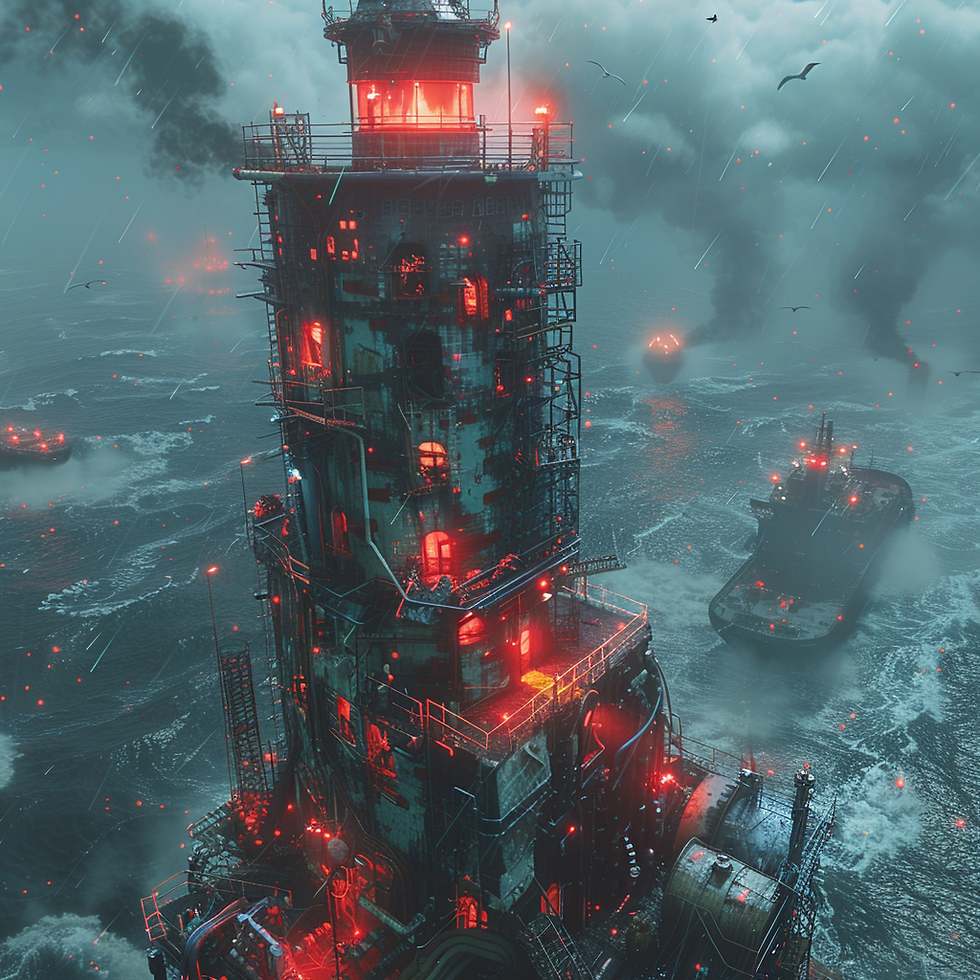
They crawled up the spit of stone between the river and the sea like forgotten secrets. Like municipal errors too big to bury. Like the weight of all the unspoken grief in a place whose future had been administrated into stasis.
The keeper had a job. Not to warn, but to watch. Not to save, but to document. For the beam was not merely light—it was a scanner, a recorder, a judgement.
Every night, when it swept across the horizon, the whole town was archived.
Every lie told in Council chambers.
Every collapsed business in the precinct.
Every promise graffitied and scrubbed.
Every mother whispering to her child that things would get better.
Every addict curled behind a Tesco Express.
Every dream deferred.
Every unspoken act of love.
All stored. All judged.
All watched from the tower.
And so the keeper grew afraid of sleep.
Because sleep meant memory. And in dreams, the beam turned inward.
It started small.
A voice, at first. Old Mersey, low and slow, gurgling through the walls. Then came the storm—though no weather moved outside. A screeching vortex that circled the glass of the lens, a hurricane of all the things he hadn’t said when he had the chance.
In one fevered night, he dreamt of the Planning Committee, transformed into gulls, picking over bones in the sand. He saw the old regeneration schemes scrawled on papyrus, fed into typewriters, then digitised into obsolete code. And from it all, a lighthouse—this lighthouse—grew upward, impossibly tall, built not from bricks but from apologies.

He awoke sobbing.
Not from fear. From recognition.
The tower was him.
And he had built it with his silence.
Later, he found the letter.
Filed in a steel cabinet welded shut. He broke it open with a wrench from the 2043 Blacksmith’s Pride Heritage Day display. The paper was old. Printed. Signed. Redacted. But one name remained—Wainwright.
Not Fortunatus, but a descendant.
A line of watchers. Truth-keepers. Shadow-scribes.
The letter spoke of “The Watchlight Protocol,” and a system known only as The Horizon Loop. That once every cycle, the beam must be turned—once—inward. That if the keeper failed to self-examine, the system would eventually turn on itself.
Which it had.
From that moment, the keeper changed.
He no longer charted the sea. He charted himself.
With each sweep of the lamp, he confronted another version:
—The child who watched ships from Egremont promenade.
—The lover who turned away when she reached for help.
—The voter who chose silence.
—The bystander.
—The cynic.
—The fool.
And finally—the man who thought he could outshine the dark by never looking in.
They found the tower abandoned.
A generation later, when storms had passed and the data-fog lifted. The lamp was still warm. The lens cracked, but not shattered. And in the keeper’s chair, folded neatly, a high-vis jacket and a set of boots, salt-bleached and faded.
The logbook was open. The final entry read:
“To shine a light on the sea is easy.
But to hold that beam against your own skin—That’s how you change the tide.”
RW


