The evidence was cardboard
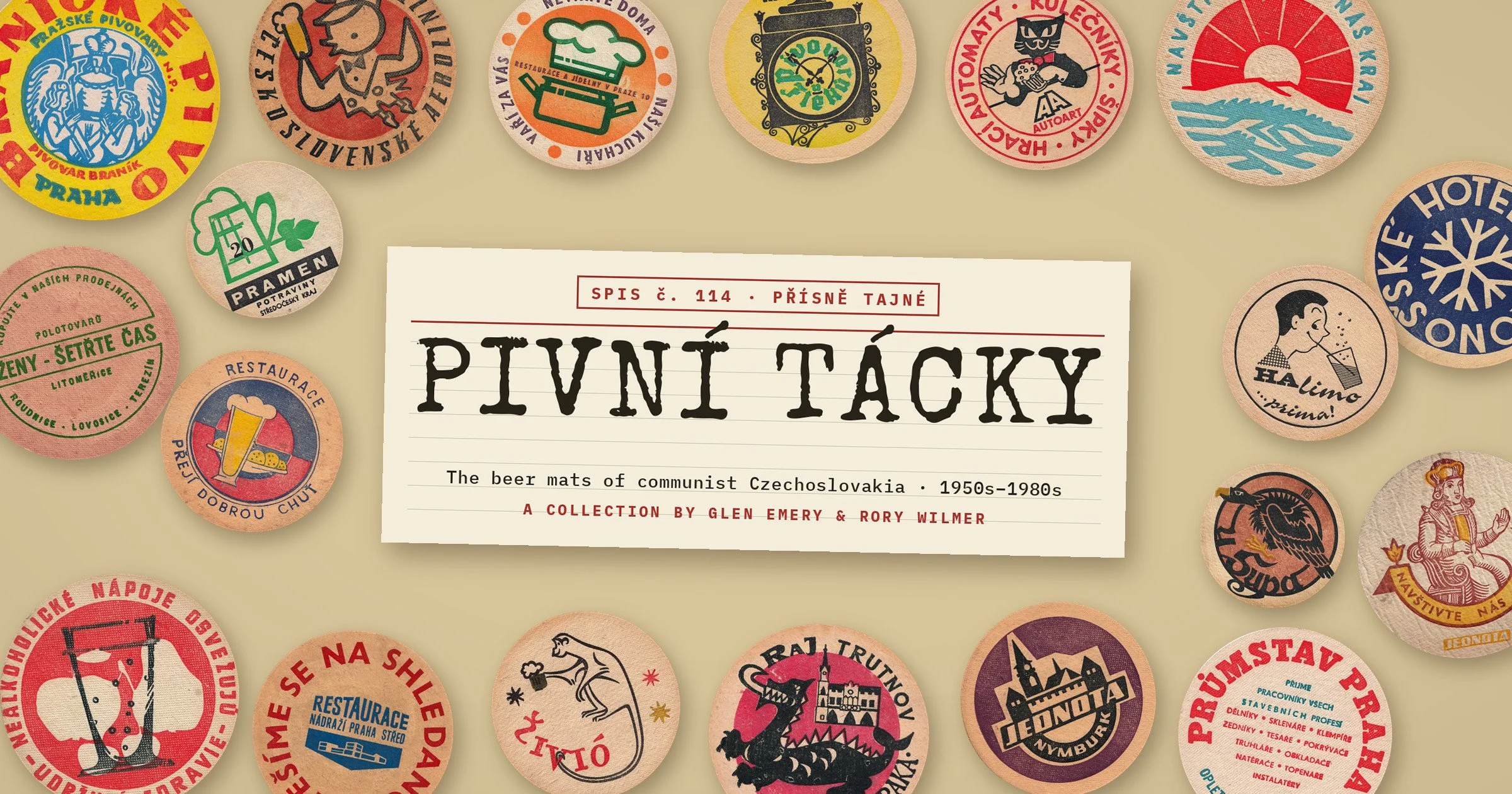
Glen Emery and I spent years hunting old beer mats across the Czech Republic. A shoebox of them survived. This is the story of that collection, the city that gave it to us, and the short film I've made to say na zdraví to Glen.
There is a shoebox.
Inside it are 114 beer mats from communist Czechoslovakia, printed somewhere between the 1950s and the 1980s. Brewery mats. Canteen mats. Mats from state hotels, village co-ops, a railway station restaurant, a national airline and the state arcade company. Every one of them is the same soft, absorbent board, a little wider than the base of a pint glass, and every one of them was rescued by the stack.
Glen Emery and I collected them over many years, travelling around the Czech Republic. Glen died in January 2024. The shoebox is still here, and it has taken me until now to work out how to do it justice.
This is my attempt. A photo story, a short film, and one day a book. But first, the story behind it.
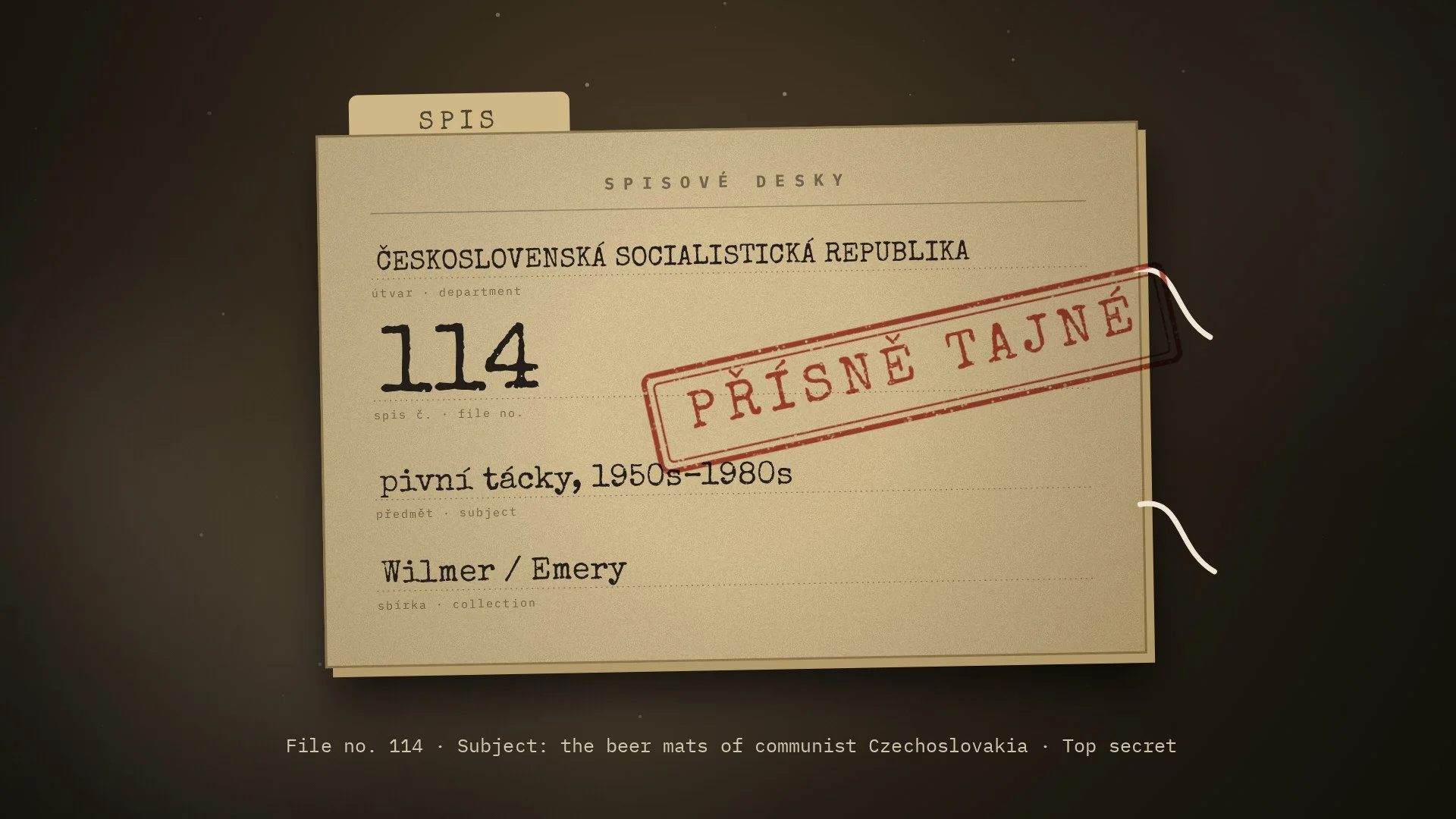
File no. 114. Top secret. A still from the film.
Prague, after the water
I first went to Prague not long after the great flood of August 2002. The Vltava had pushed its way through Kampa and Karlín and down into the metro, and the city was still drying itself out. I didn't understand what I was looking at. I just knew I wanted more of it.
A few years later I went back to live, and I stayed, on and off, for the best part of two decades.
I worked for many of the city's advertising and creative agencies. I lectured in graphic design and interaction design at college. I was marketing manager for the Disney Mobile Games Studio, part of the Walt Disney Internet Group, back when Disney had a mobile games studio in Prague.
Prague gave me a career. It also gave me an education that had very little to do with any of those jobs.
Small, beautiful things
I always had a deep interest in Czech history. But what really got under my skin was the way the Czechs make things. Graphic design. Stop-motion animation. Film. Architecture, art and music. Most of all, pop culture.
This is the country of Jiří Trnka's puppets and Karel Zeman's engraved adventures. Of Jan Švankmajer's beautiful nightmares and Pat & Mat's catastrophic DIY. Of Miloš Forman, Jiří Menzel and Věra Chytilová. Of cubist apartment blocks, functionalist villas and the Ještěd tower, sitting on its mountain like a spaceship that decided to stay. Of Smetana, and of the Plastic People of the Universe. Of Kofola, and the Little Mole.
A lot of that brilliance happened in the gaps. After February 1948 the state controlled every printing press. It decided what could be published, exhibited, screened and sold. But nobody important was looking at the beer mats.
So some of the best graphic design in Central Europe ended up on 107 millimetres of wood-pulp board, under a glass of desítka, waiting for the waiter to mark your round on it in pencil.
In a planned economy, the beer mat was one of the few advertising spaces going. There was nothing to sell you and nowhere else to go, so the mats simply wished you well. Dobrou chuť. Těšíme se na shledanou. Navštivte nás opět. Enjoy your meal. We look forward to seeing you again. Do come back.
I still find that quietly beautiful.
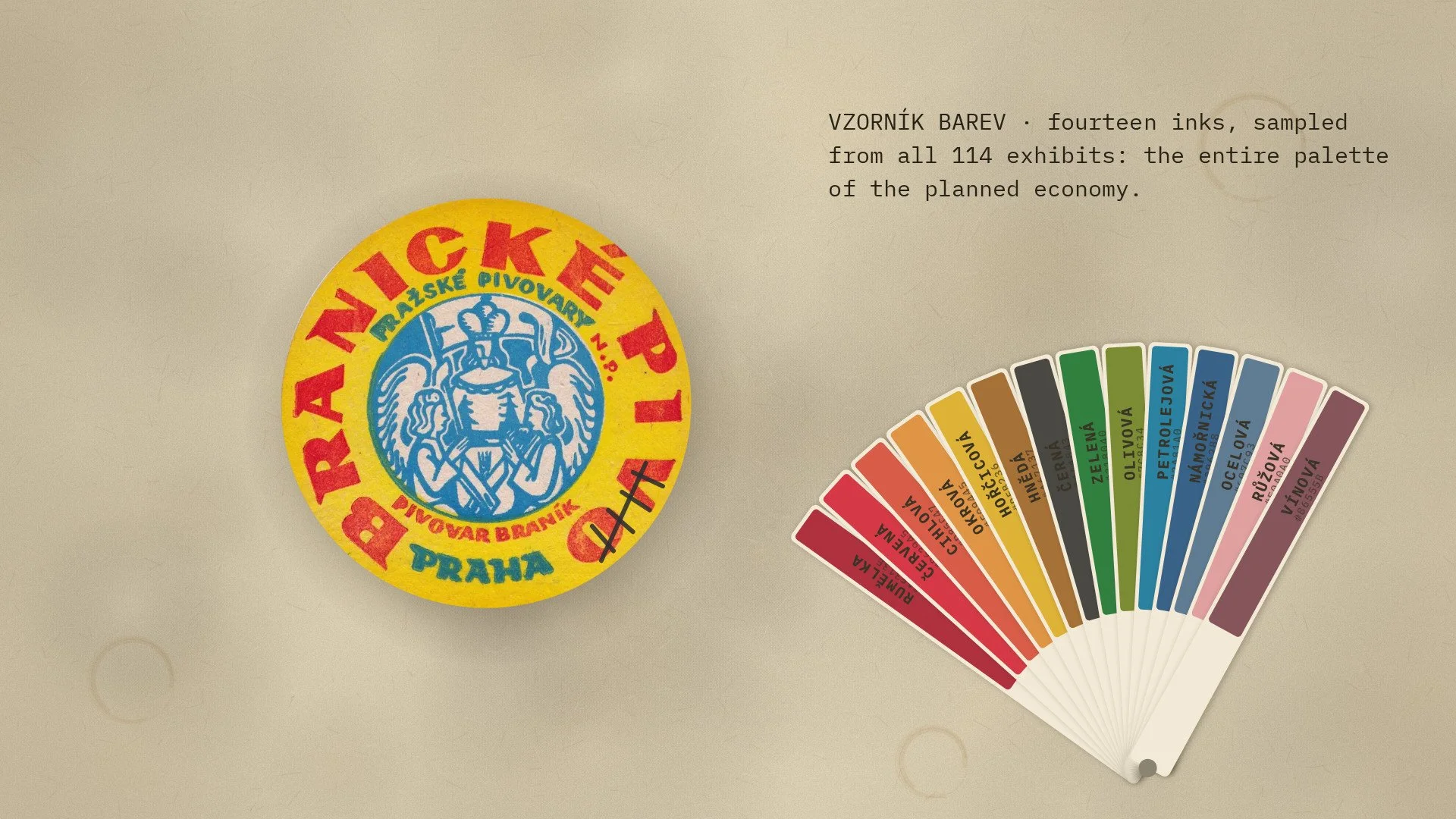
Fourteen inks, sampled from the scans: the entire palette of the planned economy.
Glen
Glen Emery was a Canadian who arrived in Prague in 1990, when the paint of the old regime was still wet. In November 1992 he opened Jo's Bar on Malostranské náměstí with his sister, Jo-Anne. As far as anyone can tell, it was the first Western-style bar in post-communist Prague, and for a few years it felt like the centre of the expat universe.
Jo's Garáž went in downstairs. Then came the Repre Klub and the Thirsty Dog in the Municipal House. Nick Cave liked the Thirsty Dog so much he dedicated a song to it. Then Železné dveře, Napa, and Bukowski's in Žižkov, which the writer Mark Baker calls arguably his biggest bar ever. In 2010 Glen even published a book, Žízniví psi. Thirsty Dogs.
If you drank anything worth remembering in Prague in the last thirty years, there is a fair chance Glen poured the first one.
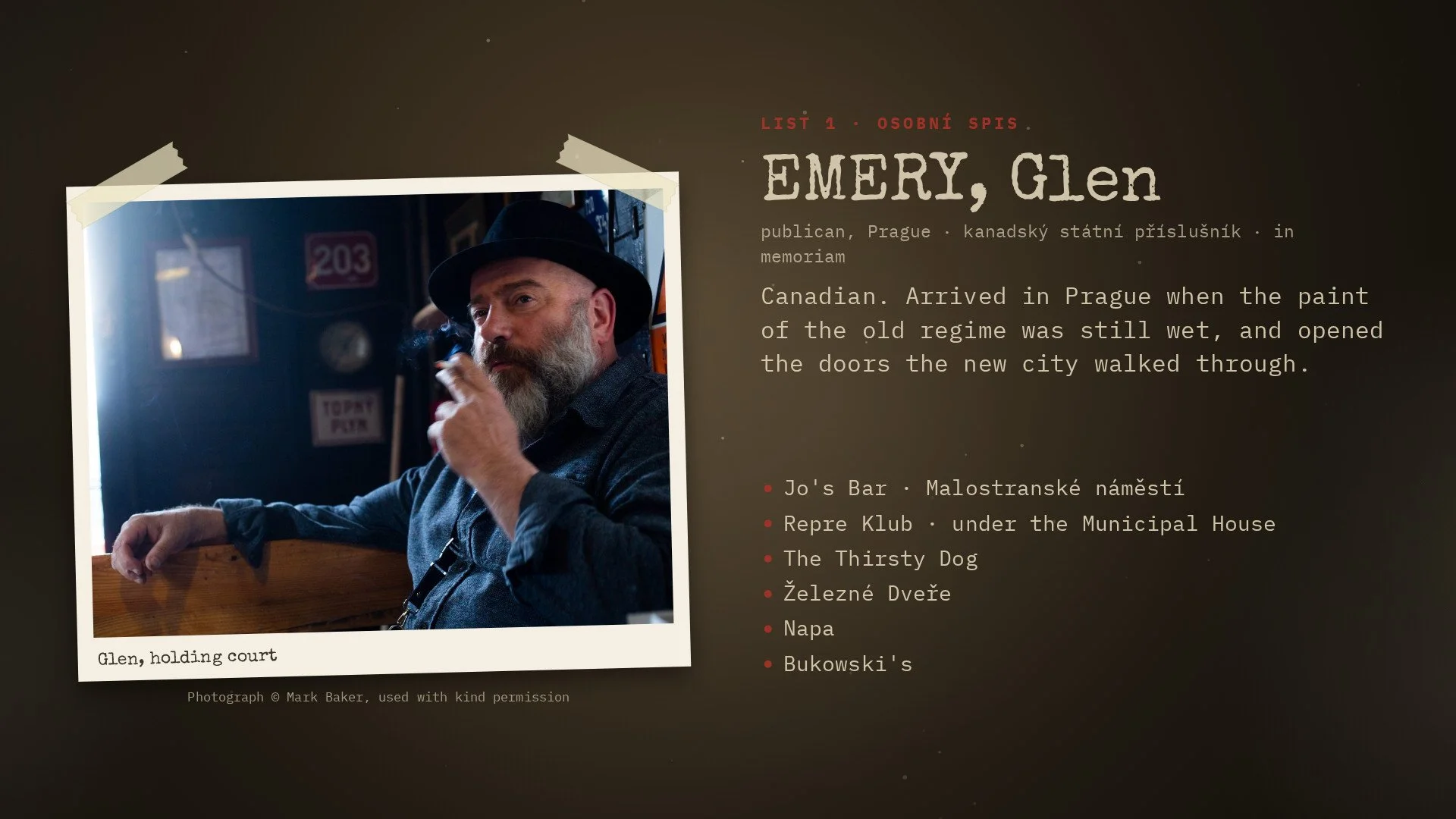
Glen, holding court. Photograph © Mark Baker
I did a lot of work with Glen over the years, mostly marketing, and mostly across a bar. I helped with the opening of Bukowski's in Žižkov, and later the Elbow Room in Letná, and Frankie's. He gave my photography exhibition, Time Gentlemen Please, a wall at Napa, his bar and gallery in Malá Strana.
And we went looking for things. Our expeditions took us all over the Czech lands: flea markets at dawn, junk shops in spa towns, attics, cellars, and the back rooms of pubs that hadn't changed their curtains since 1974. We were after Soviet and Eastern Bloc memorabilia, antiques, and above all the stories of the people and places attached to them.
People talked. Glen listened. Everything interesting came home.
One of the things that came home was a shoebox of beer mats.
Custodian of the brand
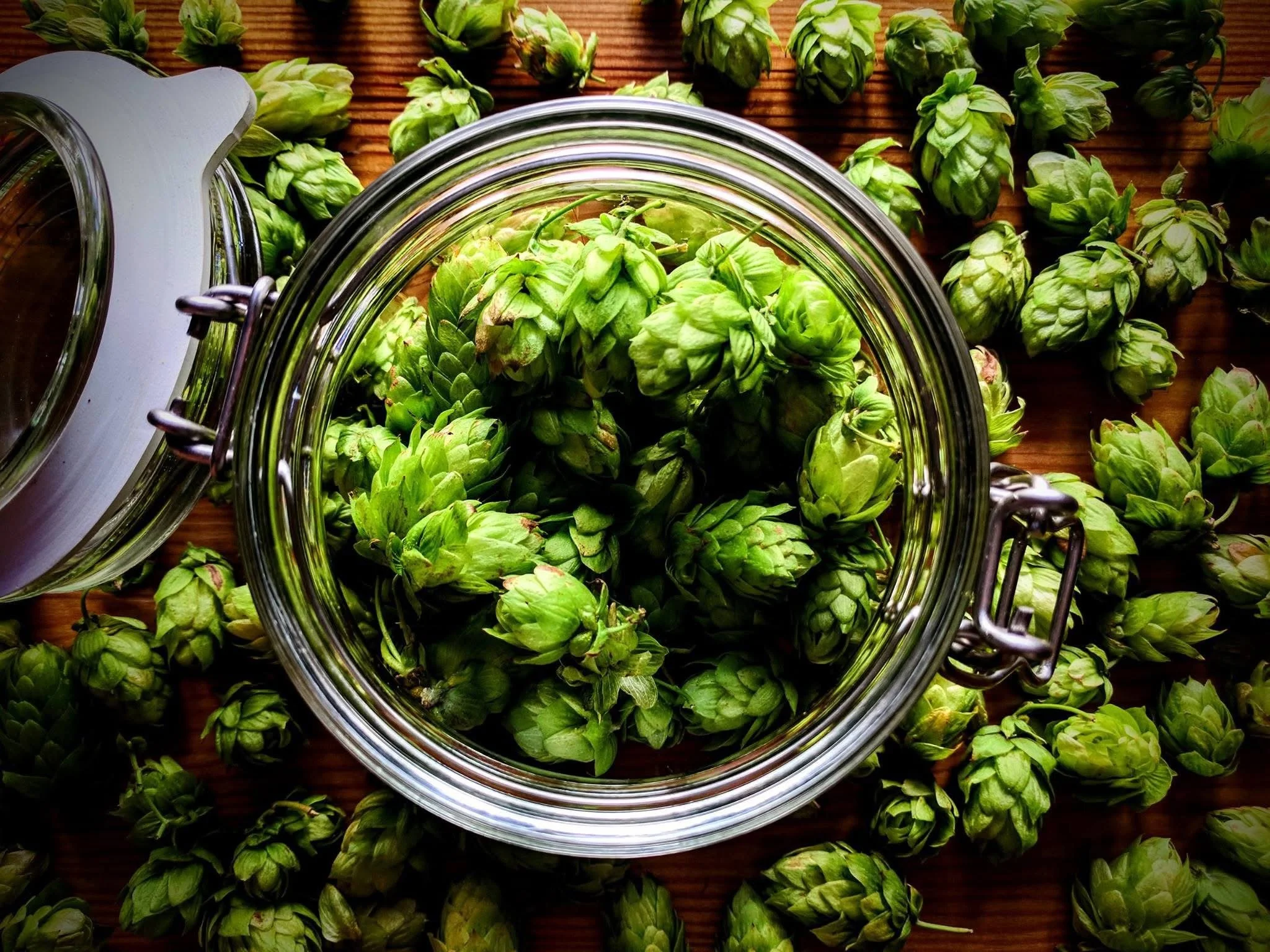
Beer followed me through my whole Czech life, and for two years it was my actual job.
Pilsner Urquell had just changed hands. When AB InBev bought SABMiller, Europe's competition regulators made it sell off the Central and Eastern European breweries, and in March 2017 Asahi bought them, Pilsner Urquell included.
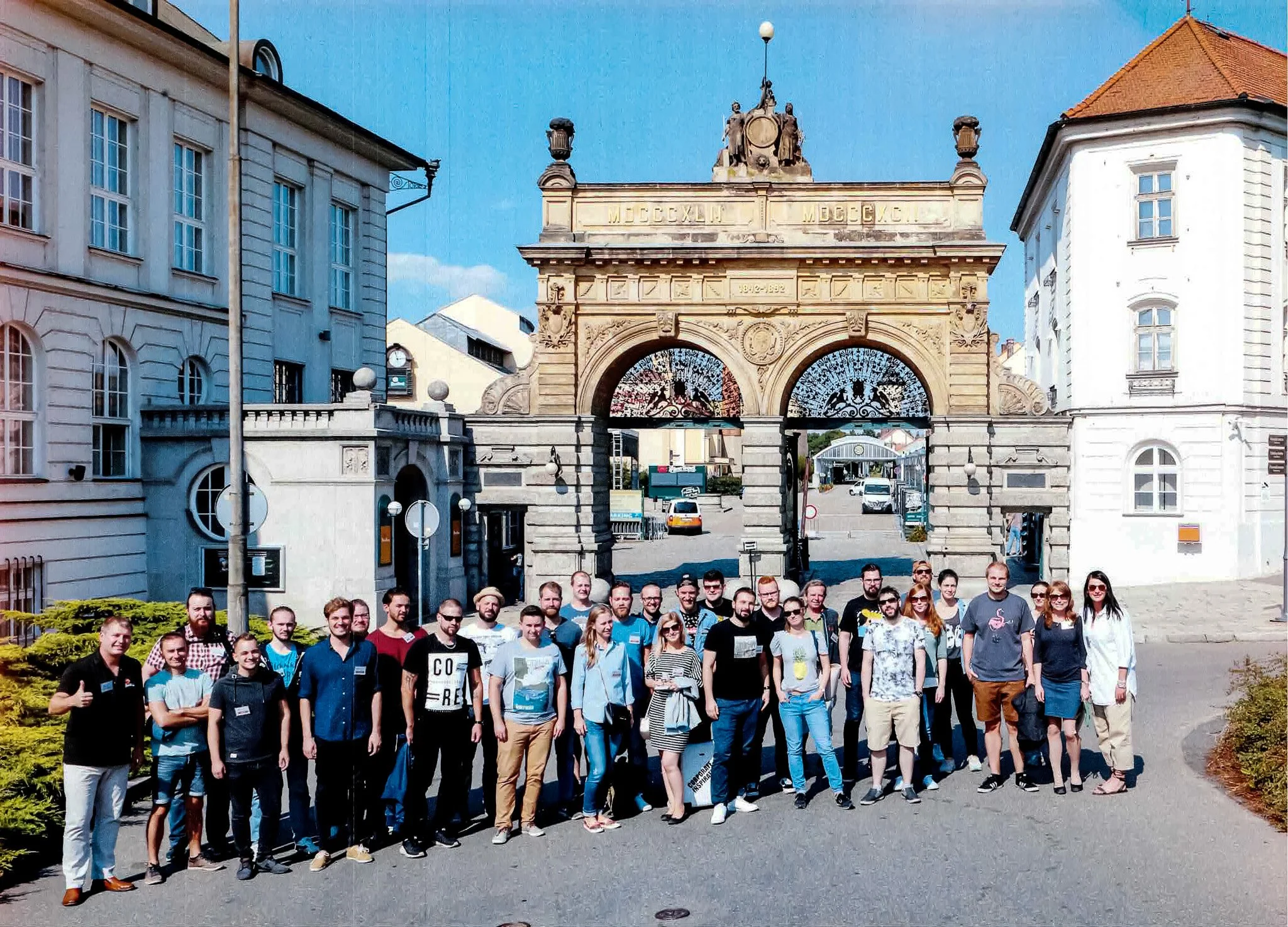
The gatekeepers of the brand! Myself, middle back row.
Not long after, I had the honour of leading digital and brand strategy for Pilsner Urquell. I was lead digital and brand strategist at Mustard, a creative agency in Prague, and we were leading the global marketing for the original golden pilsner, first brewed in Plzeň in 1842. I supported the rest of the Czech portfolio too, from Gambrinus to Kozel and Radegast.
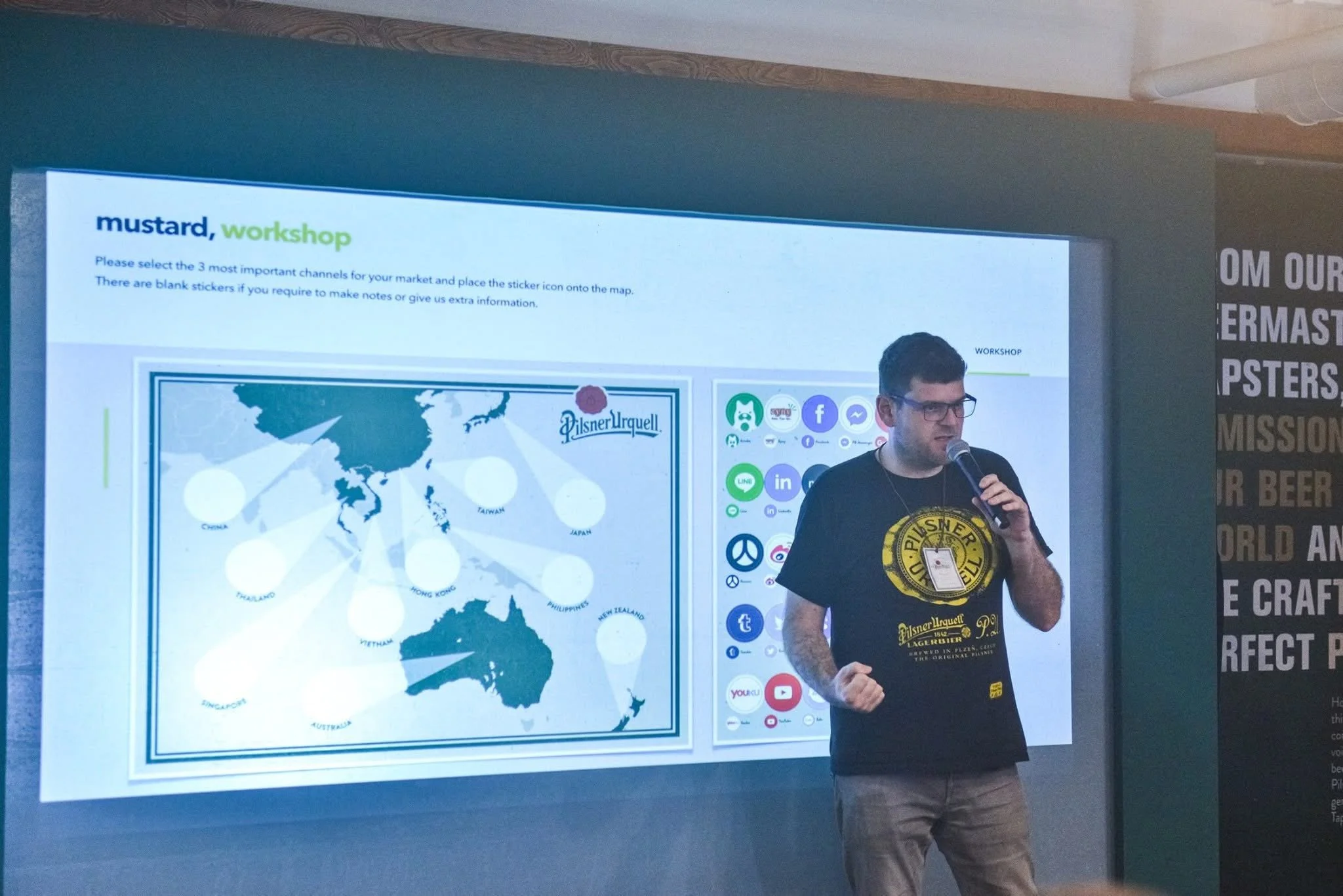
Workshop with the Asia-Pacific markets: pick the three channels that matter most in yours.
It took me out to Asia, to Hong Kong and a great deal of time in Seoul, making work for the Asian markets. It took me all over Europe, Poland and Germany especially. Workshops, conferences, brewery events, and a great many mugs raised. I flew around the world, drank Pilsner Urquell, and got paid to do it. I'm still not entirely sure how I got away with that.
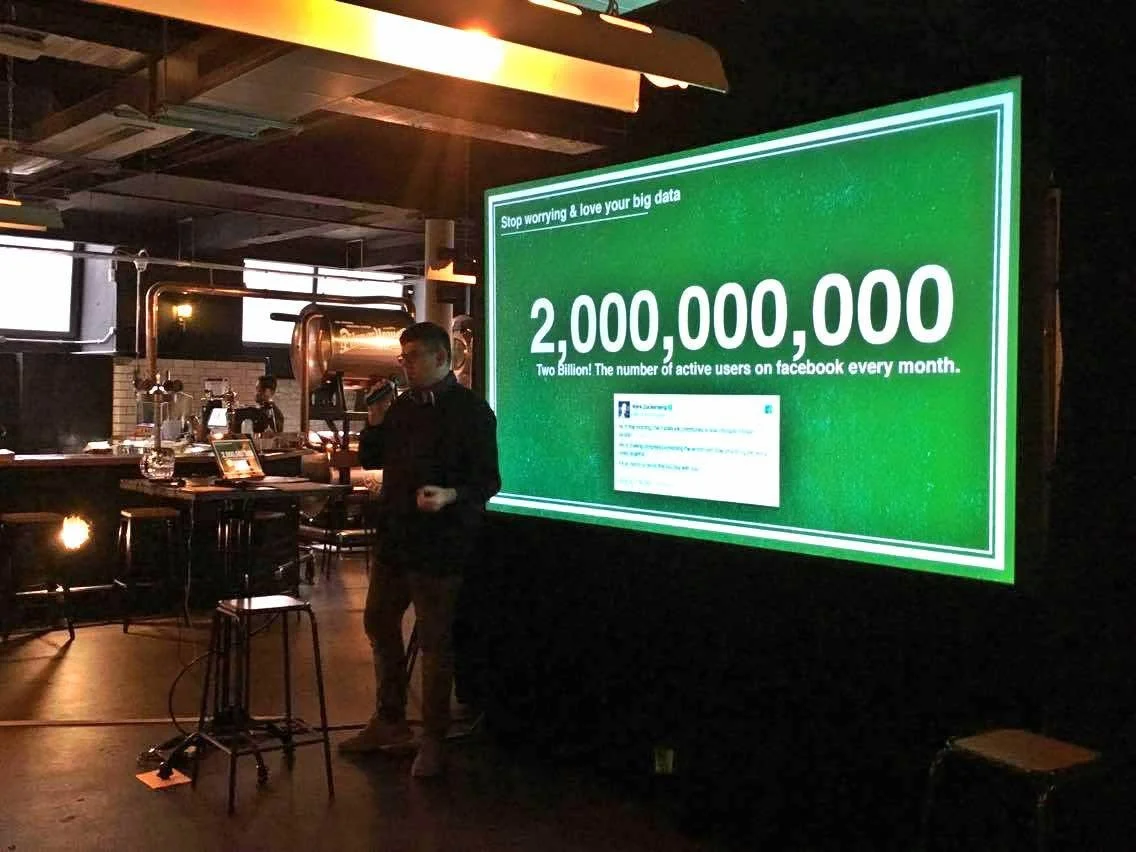
Stop worrying and love your big data.
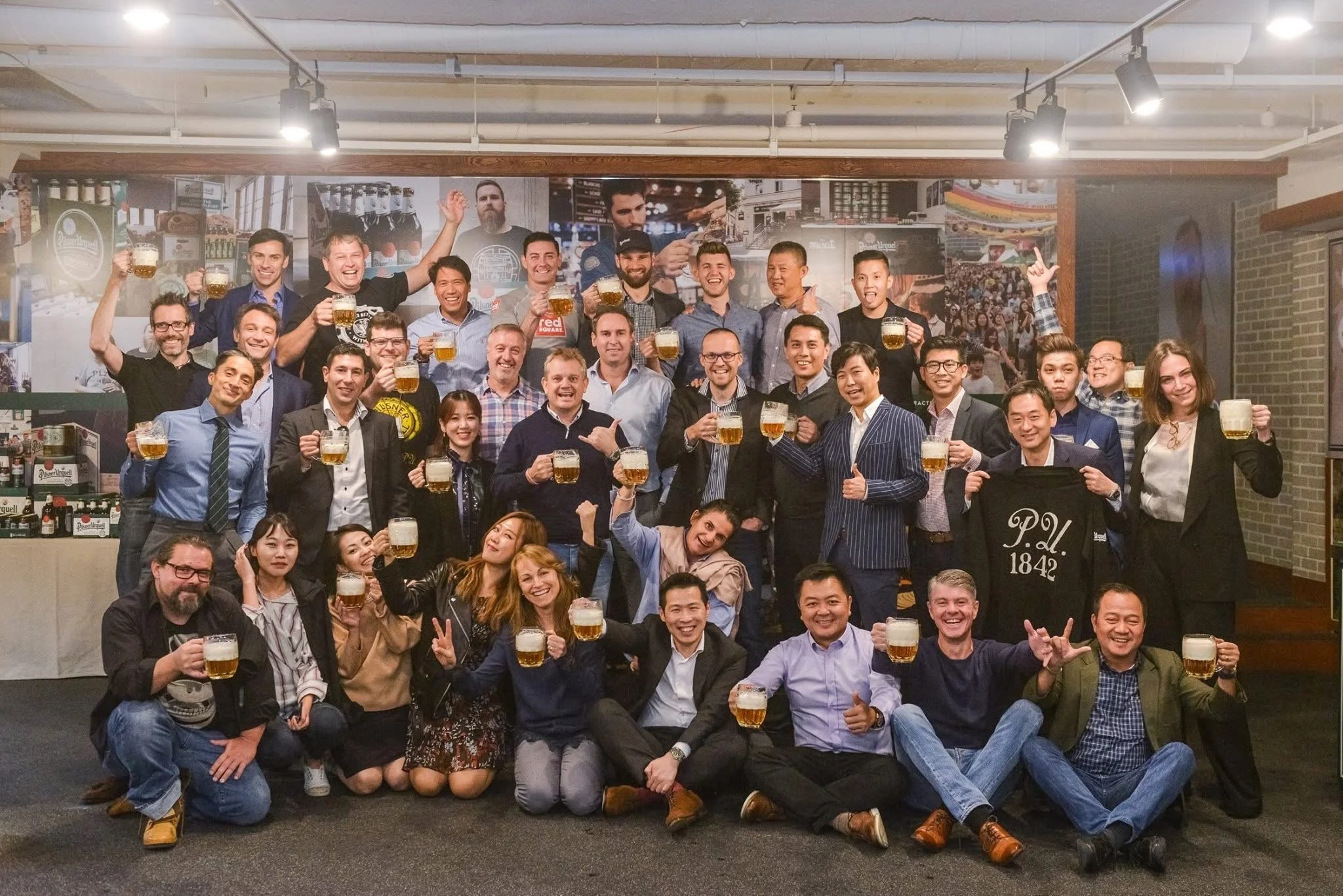
Mugs up. The global Pilsner Urquell team and the Asian market brand managers
As custodian of the brand, I spent a lot of time at the brewery in Plzeň, with access to its incredible archives. And I got to work with, and learn from, Robert Lobovsky, Pilsner Urquell's beer master, the man some people simply call Mr. Pilsner Urquell. His passion for beer, and for Pilsner Urquell above all, was something else. You could not spend an afternoon with Robert and come away thinking beer was just a drink.
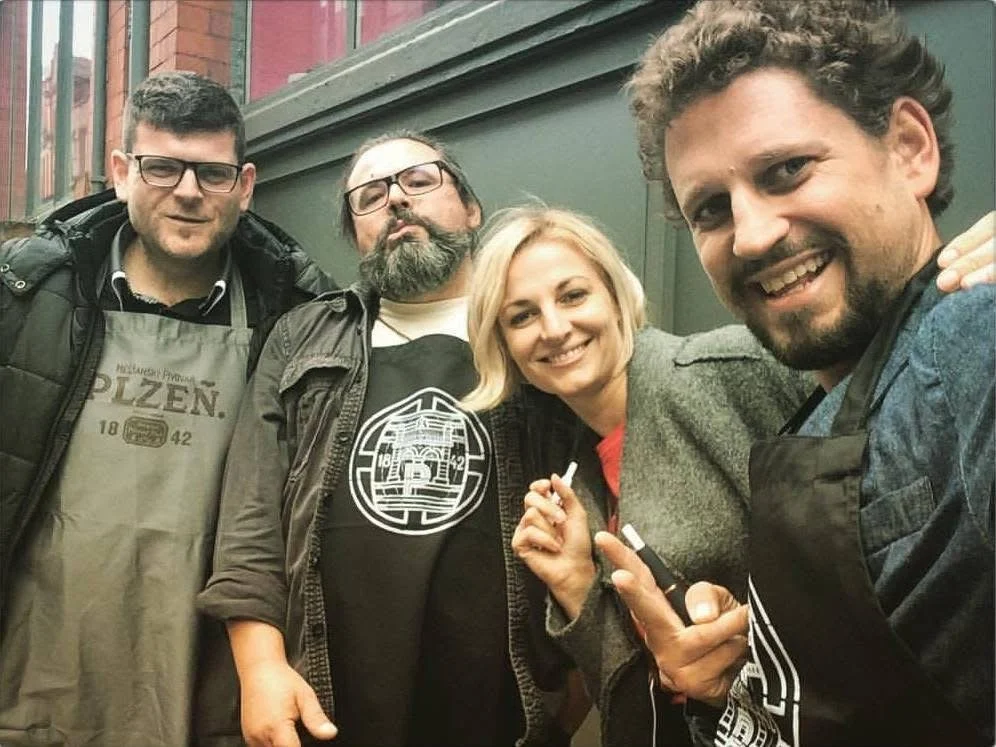
Aprons on. The Inglorious Mustards at Pilsner Urquell EU workshop in Manchester, UK.
Some of my favourite work was the silliest. For April Fool's Day we made two perfumes, created for beer lovers: Hladinka and Mlíko, named after two of the classic Pilsner Urquell pours. Hladinka is the proper pour, with three fingers of foam. Mlíko is a glass of wet foam with just a little beer at the bottom.
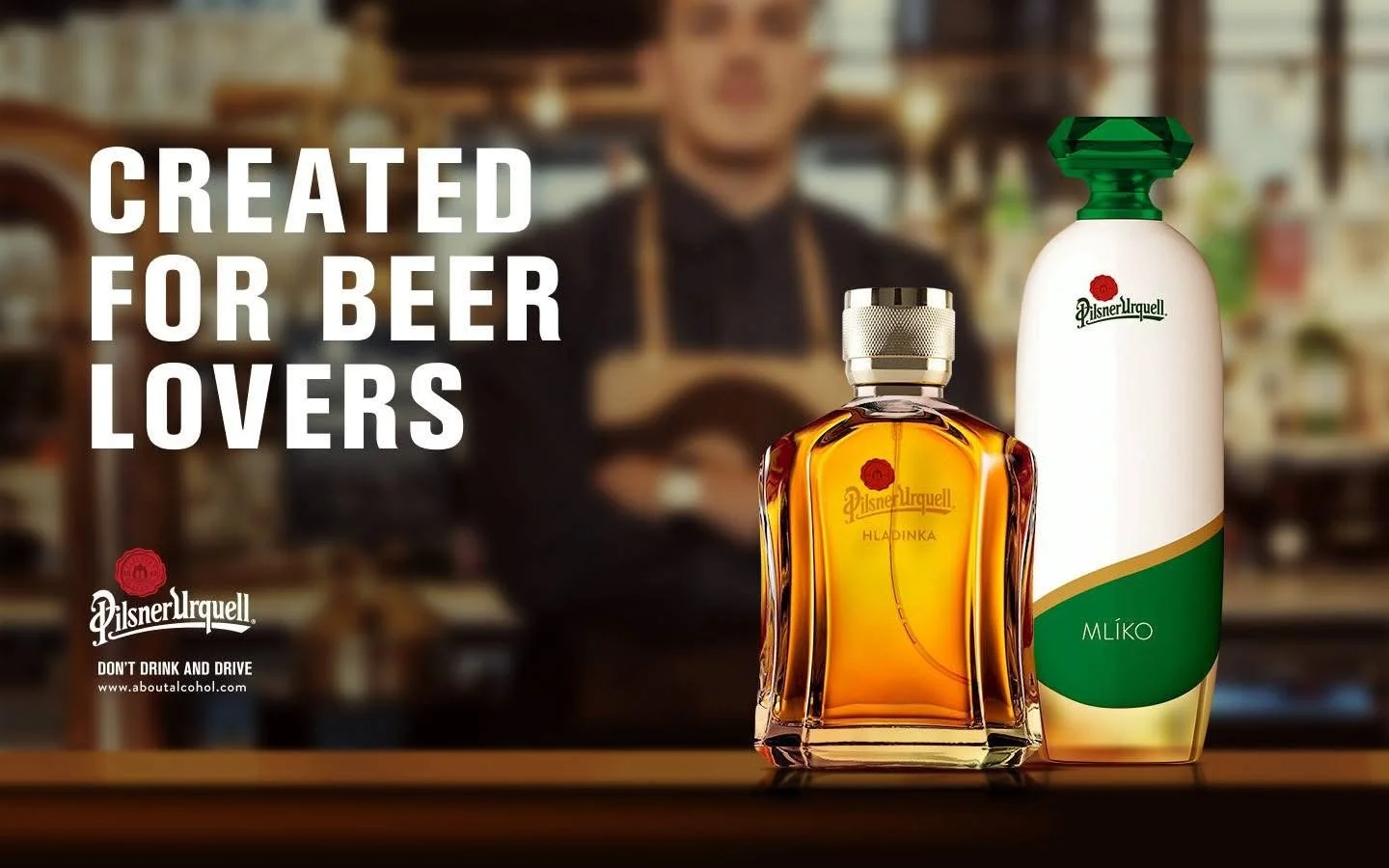
Created for beer lovers. An April Fool's Day joke.
Then there was a concept I still think somebody should make: Pilsner Urquell potato chips, seasoned with Saaz hops, the same hops that go into the beer.
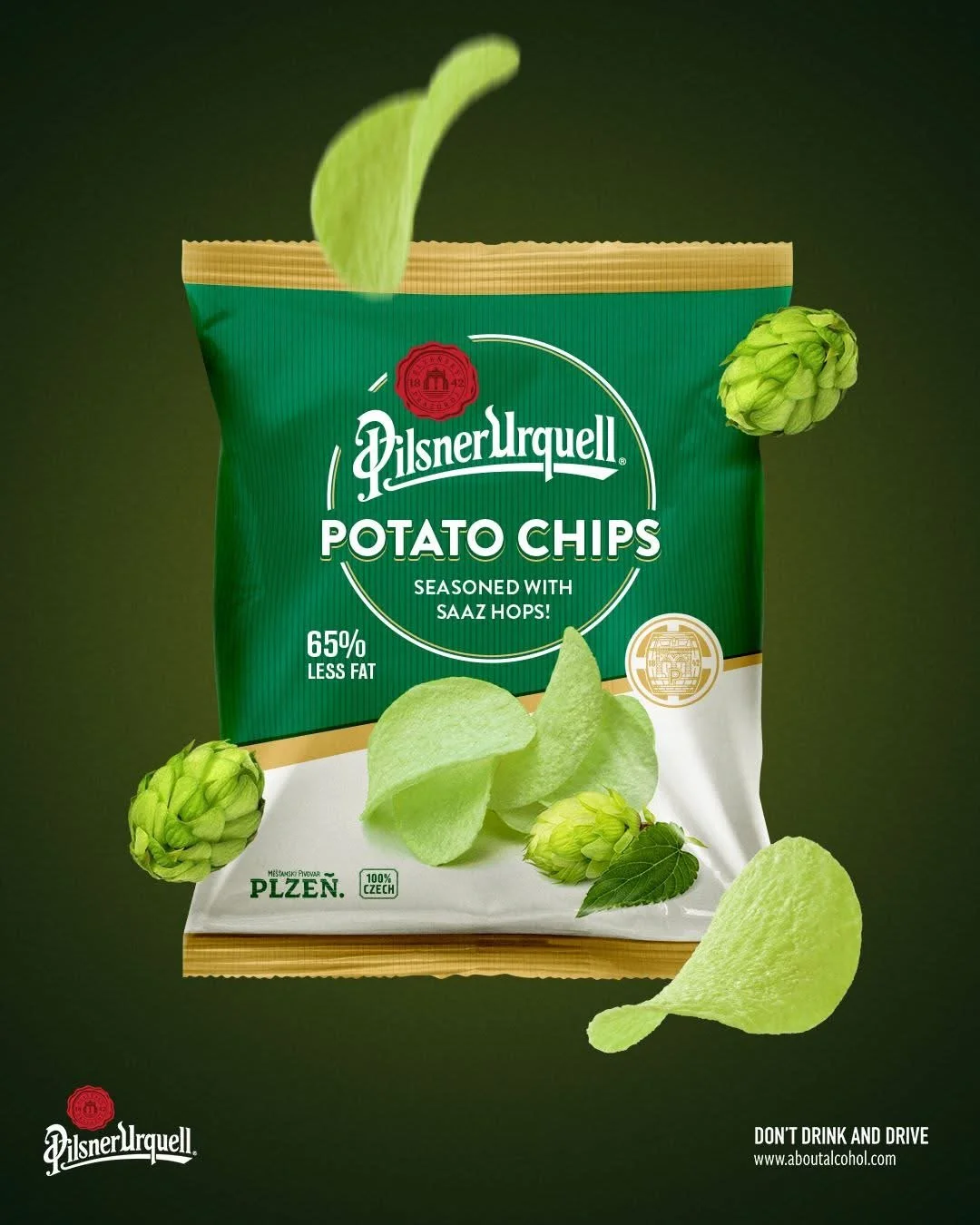
Seasoned with Saaz hops. A concept I created for food pairing.
Looking back, those two years were a postgraduate course in exactly what this collection is about. How a beer looks. How it's poured. How it's remembered.
Weekends in Franconia
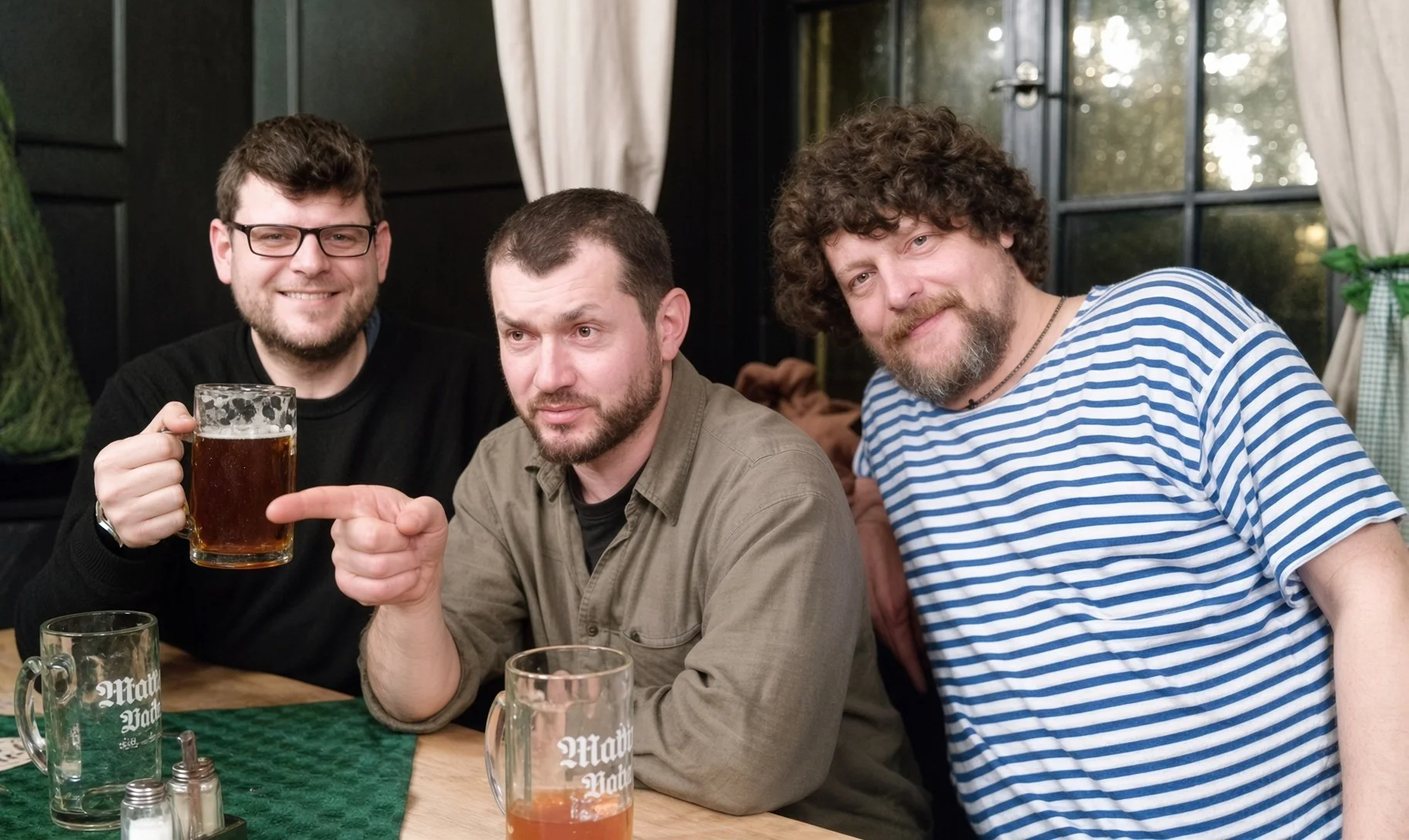
Myself, Honza and George.
Czech beer culture doesn't stop at the border, and neither did we. With dear friends, Glen, George and Honza, I would head over to Bamberg in Franconia for weekends of sampling and testing the local beers. Upper Franconia has more breweries per head than anywhere else in the world, and Bamberg is the home of Rauchbier, a smoked beer that tastes like a bonfire in the best possible way. We took the research seriously. Somebody had to.
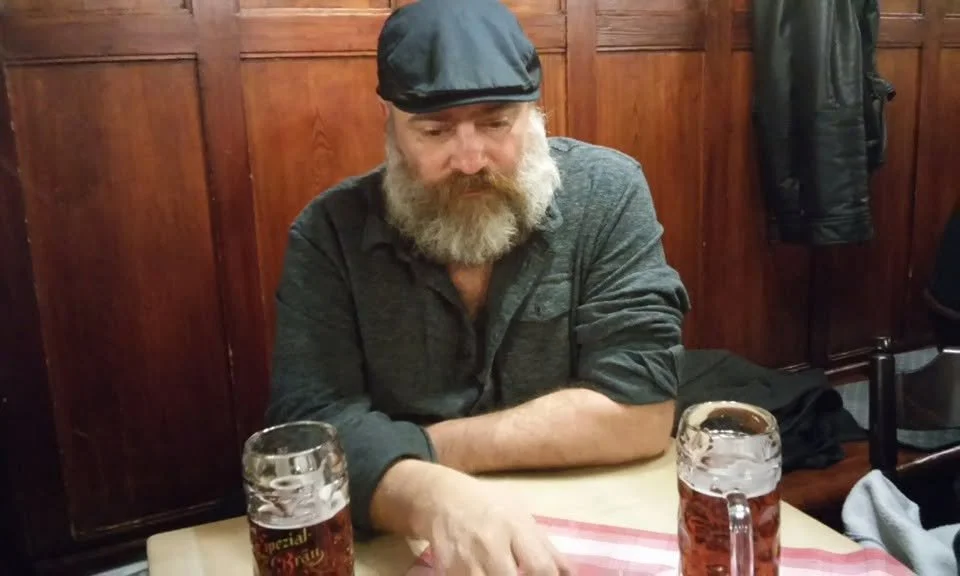
Glen contemplating his next Schnapps.
Beer culture in that corner of Europe is something else. It isn't about getting drunk. It's about the table, the glass, the conversation, the regulars in the corner and the waiter who already knows your order. It's about the mat under your glass keeping count.
I was so honoured to be part of it. That's why this beer mat project means so much to me.
The file
Years ago I scanned every mat in the shoebox. Then I did what any sensible person would do with 114 pieces of cardboard. I opened a secret police file on them.
Pivní tácky (Czech for beer mats) is a photo story built as an StB dossier. File number 114. Top secret. It's dedicated to Glen, and it runs to four volumes:
Svazek I · Pivovary: the nationalised breweries, from U Fleků to Braník. 22 exhibits.
Svazek II · Dobrou chuť: RaJ, the state restaurant trust, wishing you a good appetite. 40 exhibits.
Svazek III · Jednota: the village co-op, plus the airline, the arcade and the oddities. 33 exhibits.
Svazek IV · Na výlet: state hotels, mountains and spa towns. The organised weekend. 19 exhibits.
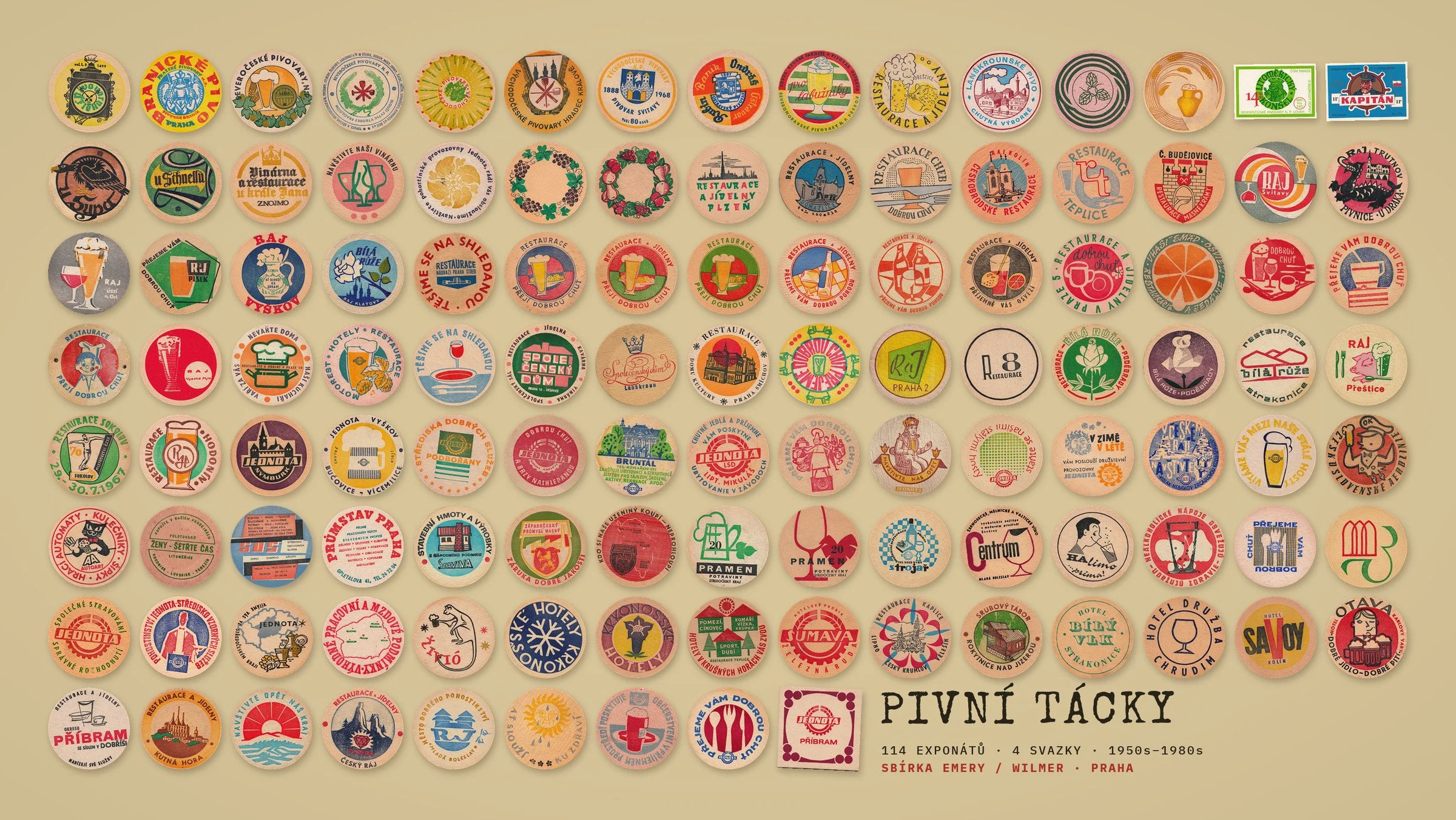
All 114 exhibits.
The file describes the object for the record: 107 millimetres of absorbent state cardboard, one to three spot colours, function: coaster, receipt, and now evidence. It samples the fourteen inks that make up the entire palette of the planned economy. It maps the apparatus of thirst, from the Central Committee of the Party down through the Ministry of Trade and the national enterprises to the cardboard under your glass.
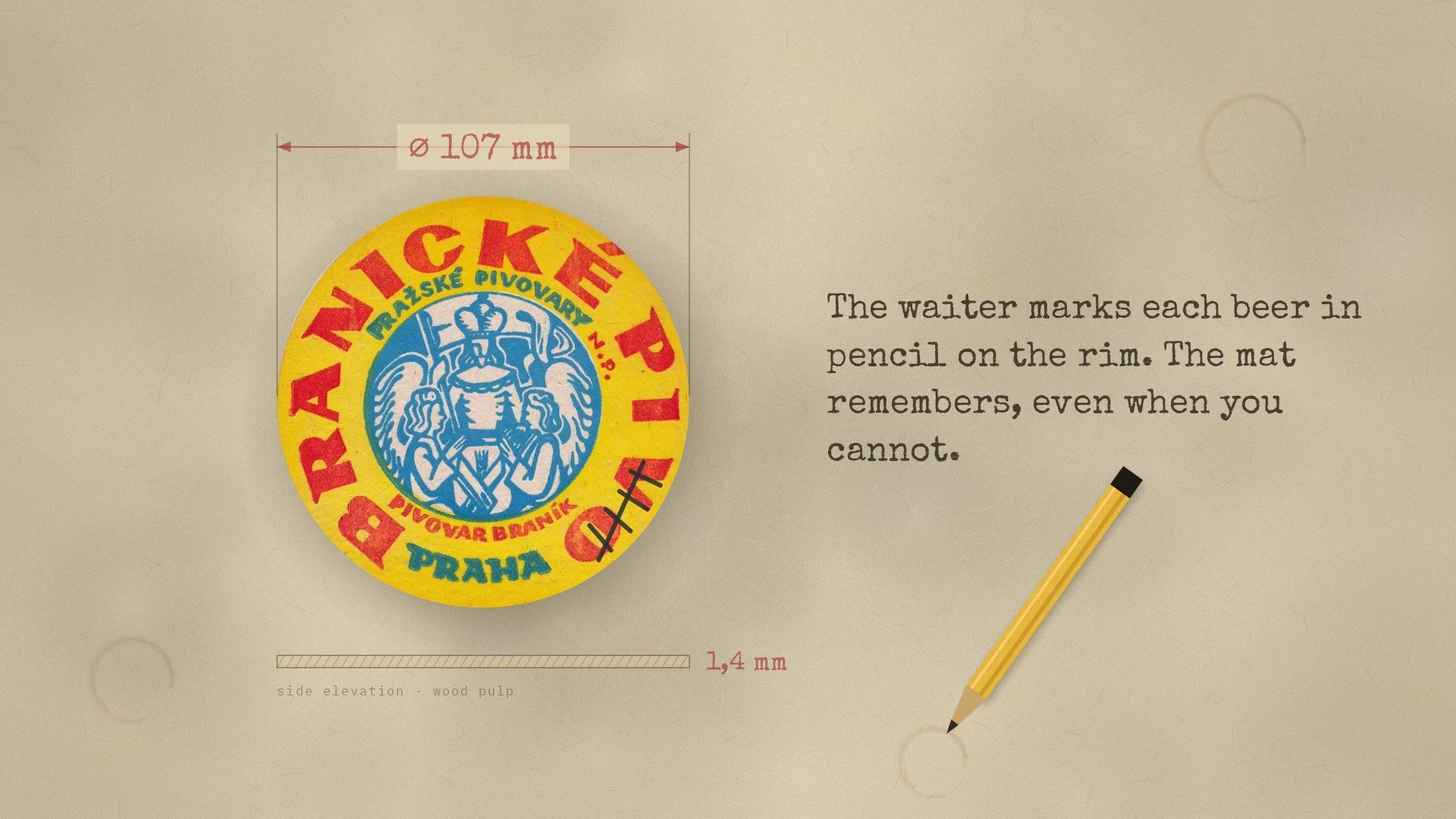
The waiter marks each beer in pencil on the rim. The mat remembers, even when you cannot.
Everyone has favourites. Mine include the dragon on the mat from Pivnice U Draka in Trutnov, the finest beast in the file. The chef's hat on NEVAŘTE DOMA! Don't cook at home, our cooks will cook for you. The ČSA mat, from the years when Czechoslovak Airlines became the third airline in the world to fly jets. And the red sun over blue water on Navštivte opět náš kraj, visit our region again, from a country that rarely let you visit anywhere else.
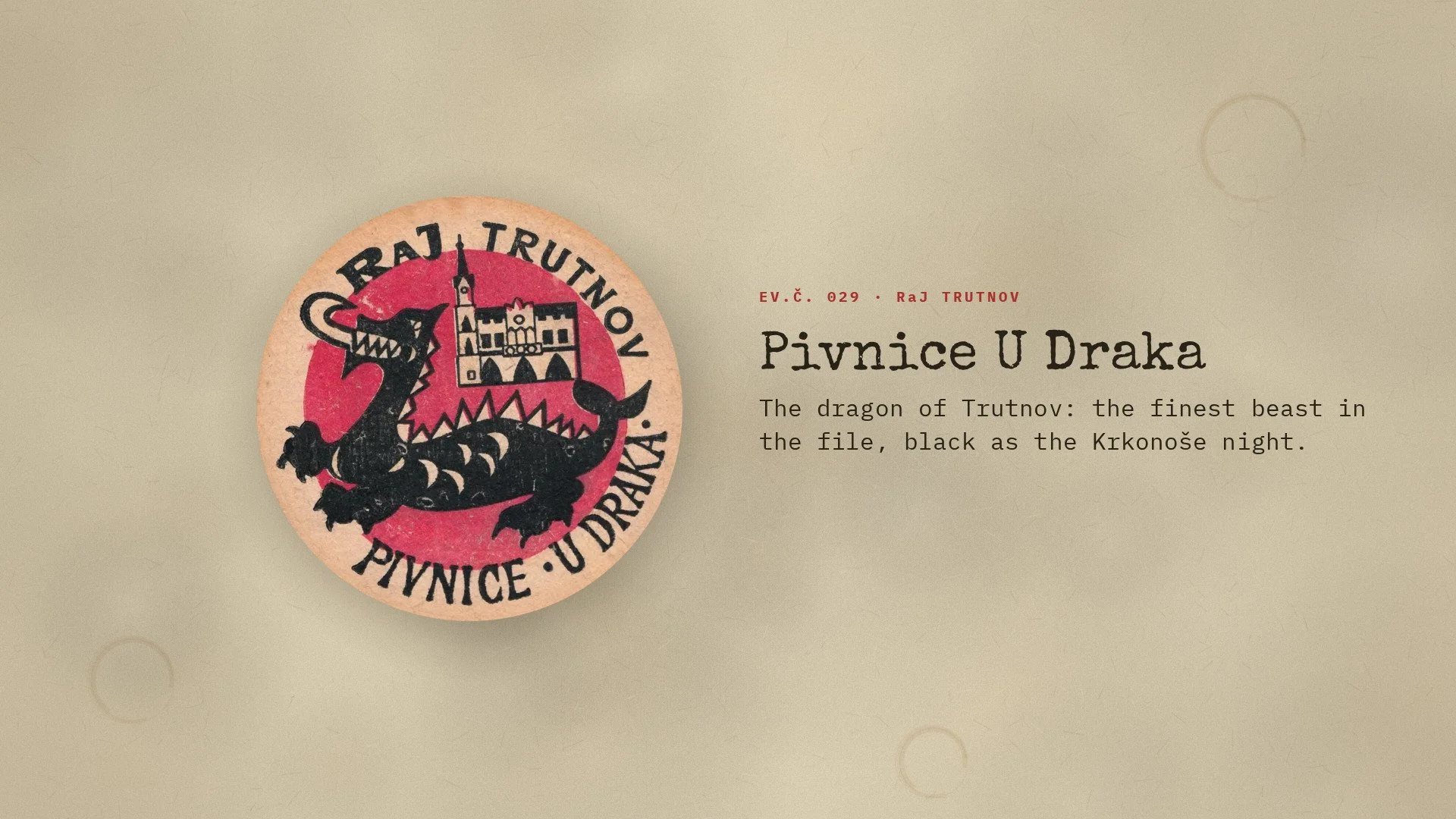
The dragon of Trutnov, the finest beast in the file.
The film
Now the file is a film.
Pivní tácky is a 3 minute 42 second animated film, built from the original scans. Every mat you see in it is one of ours. It opens like a case file, with a PŘÍSNĚ TAJNÉ stamp coming down on the folder. It walks you through the object, the inks and the history: the first golden lager in 1842, the first cardboard coaster in 1880, the wood-pulp mat patented in Dresden in 1892, and February 1948, when the Communists took power and the breweries passed into national enterprises.
Then it opens the four volumes, one exhibit at a time, before a timeline runs from 1948 to 1989. A desítka costs 1.70 Kčs, and will for seventeen years. In August 1968 a small tank with a red star rolls across the timeline, and the mats keep saying dobrou chuť. In November 1989 keys jingle on Wenceslas Square, and the file closes itself.
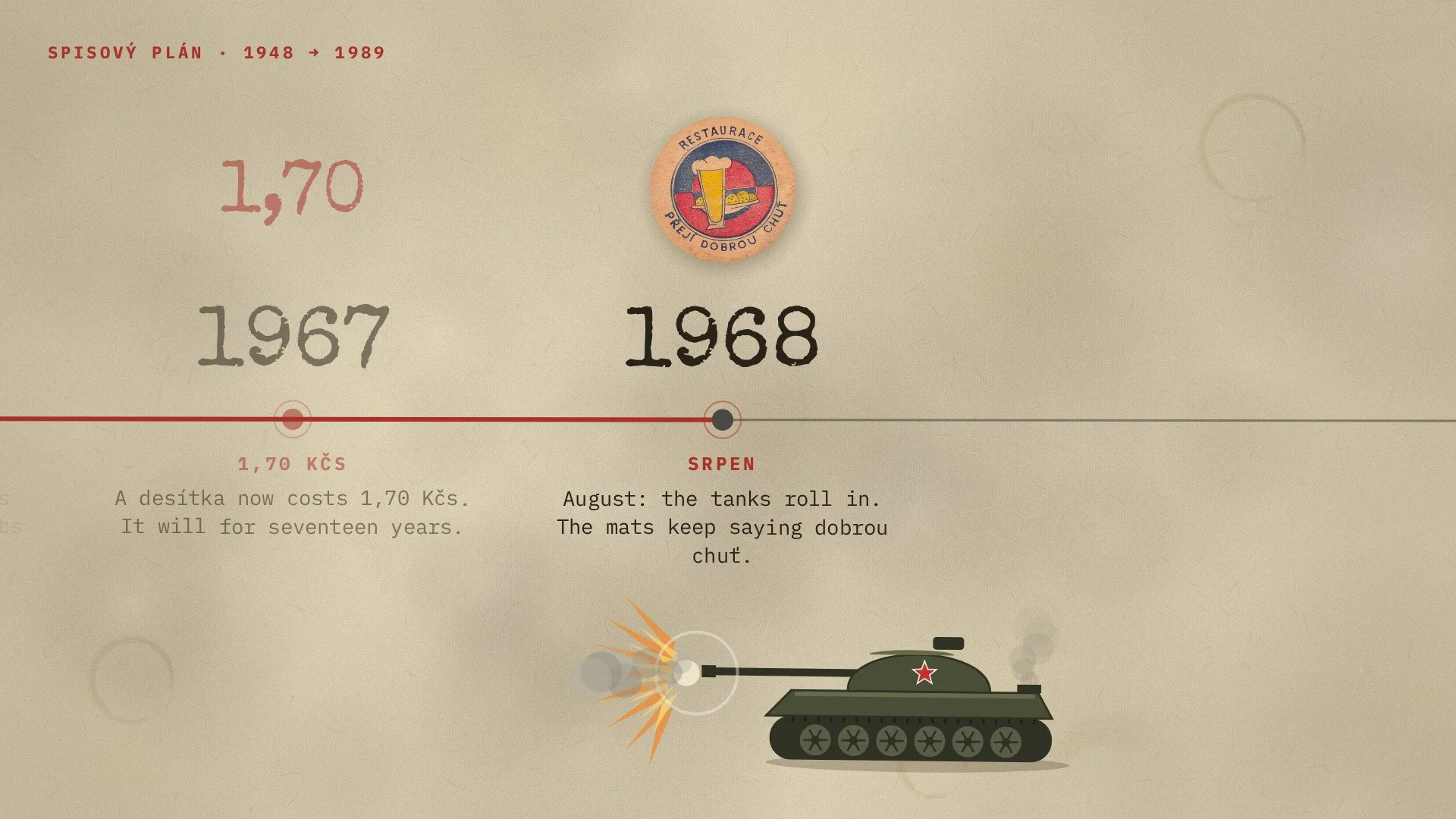
August 1968. The mats keep saying dobrou chuť.
Glen gets his own chapter, in Mark Baker's photograph. Hat on, cigarette lit, mid-story. And then comes the closing report, which says everything I've tried to say here in a single paragraph:
“The investigation finds as follows: that a state which controlled every printing press spent forty-one years printing courtesy; that its best artists hid in the beer-mat department, where nobody important ever looked; and that the evidence, being cardboard, was left on tables in full public view, where two foreigners with pints eventually collected it.”
The film ends with all 114 mats landing on the table, one by one, and a red stamp. SPIS UZAVŘEN. File closed.
The score is Pohled na horu, A View of the Mountain, written in the spirit of the great Czech composers. If you hear a little Smetana in it, that's the point. Watch it with the sound up.
Next, the book
The next step is a book. A proper coffee table book, with room for every mat, every story and for Glen. Something heavy enough to hold a glass steady. For now there's the photo story and the film. The book is coming.
Na zdraví, Glene
It isn't really a shoebox of beer mats. It's Prague. It's the best part of twenty years of friends, bars, agencies, lecture halls, brewery archives and long nights. It's the best graphic design nobody bothered to censor. And it's Glen, who listened while everybody talked, and made sure everything interesting came home.
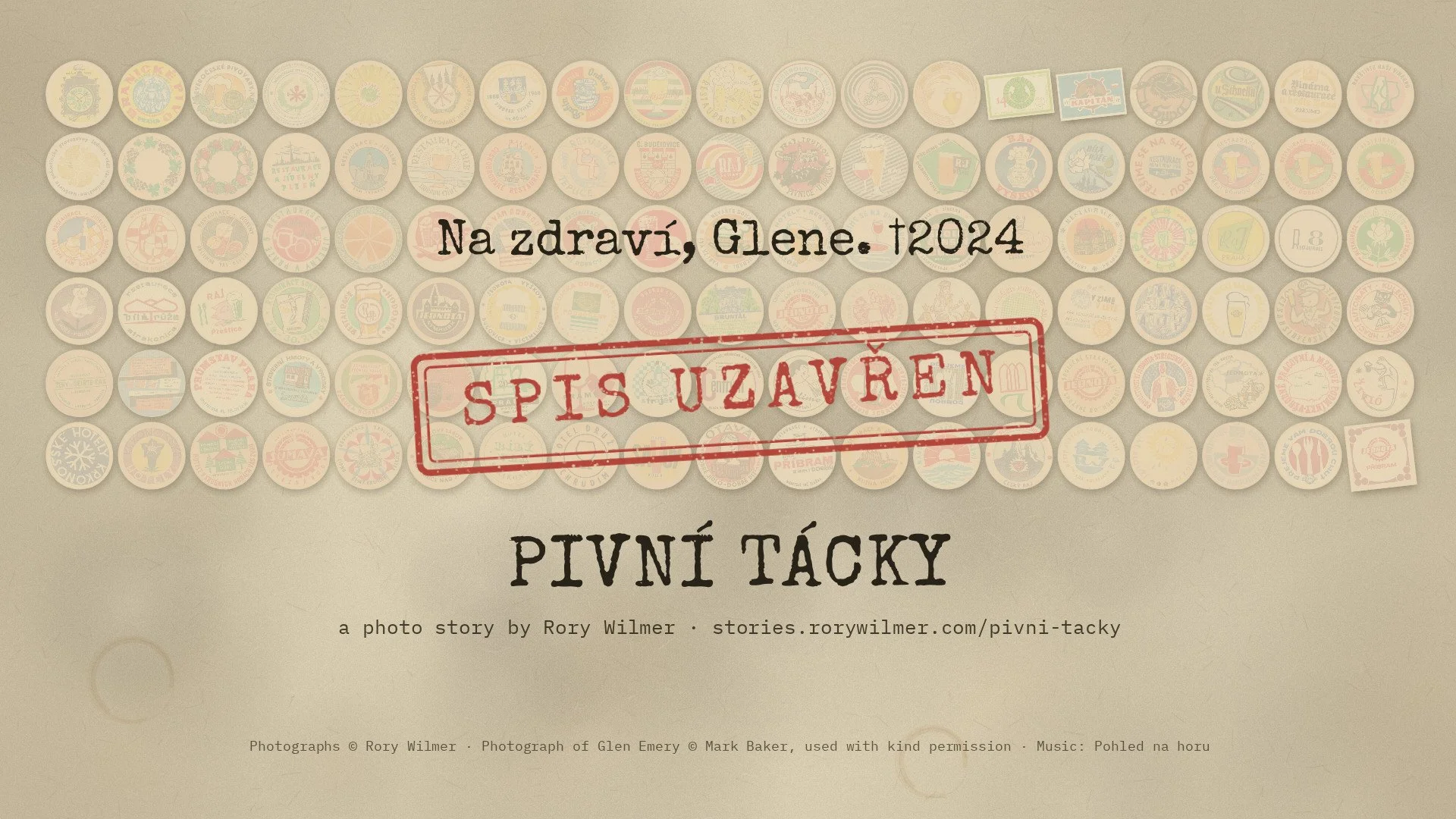
Na zdraví, Glene.
SPIS UZAVŘEN. File closed.
Open the file: Pivní tácky · Remembering Glen Emery, by Mark Baker · More photo stories · rorywilmer.com
Photographs and scans © Rory Wilmer. Photograph of Glen Emery © Mark Baker, used with kind permission. Music: Pohled na horu.
